h1

Back to School

August 21, 2012

It’s that time of year again. This is the beginning of my tenth year at Indiana University.  It’s a great place to work, being surrounded by energetic students and devoted faculty.

I’ve had a terrific summer.  Among the highlights are soloing with the IU Summer Concert Band, playing with Michael Feinstein and the Cincinnati Pops, performing a few weeks including July 4 with the Indianapolis Symphony Orchestra, teaching at the IU Summer Music Clinic, and of course teaching and performing at Birch Creek.

Now that the school year is underway, it’s time to make a plan for what to accomplish this year.  There are probably a lot of demands on your time during the school year.  That’s precisely why it’s so important to have an idea of what you want to do.  Among the many built in activities such as band, orchestra, jazz band, classes, lessons, friends, and other very important ways that people spend time, like watching basketball (necessary), football (enjoyable), and Fringe (a show you should be watching), it can be easy to lose focus.

Here’s what I want you to do:

  • Make a list of your biggest technical weaknesses.
  • Make a list of music you want to learn.

Put these lists somewhere you see them every day. 


If you really work addressing both lists, at the beginning of next semester you should be able to make two new lists.  If you’d like, please leave your lists in the comment section, and we’ll come back in January and see what the new lists look like then.

Okay, get to work.

h1

Please think- and play.

May 16, 2012

We’ve all heard this phrase:

“Don’t think-just play.”

This phrase has bothered me since the first time I heard it.  Without thought, it’s not possible to get better or have your best performance.  There are certainly people that practice their technique by just going through the motions.  And then play music by taking their best shot without a lot of thought.  This seems like a risky (and ineffective) way to go.  

So let’s figure out what to think about.  

When practicing fundamentals, think about:

  • perfecting technique.

When practicing music, think about:

  • any technical problems that need to be addressed to be able to play the piece
  • all musical decisions to be made for performance

Now that you’ve practiced this way, it’s time for the performance.  This is the only thought I want in your head:

Here’s how I want this to sound

When it’s time for a performance, think about the music you want to create.  If you’ve practiced effectively, you’ve addressed all of the technical issues and made all of the musical decisions.  The only thing left is creating music.  So think about exactly how you want it to go.  

So please think, both in your practice and your performance.


h1

What I did this Summer

May 8, 2012

Picture yourself a few months in the future.  It’s August or September- it’s the first day of the school year.  You’re seeing all of your friends and they are all telling stories about what they did over the summer.

What story do you want to tell?

So here’s your assignment for the summer:

  • Write a note from the first day of the ’12/13 school year telling yourself what you accomplished over the summer.
  • Read it every day.

It does not have to be complicated.  Think about what you want to improve, or any projects you want to tackle.

Here’s one of mine:  I’m a Mac person.  That may not be a strong enough term, as I have an iPhone, iPad (thanks again Dad), and a 15″ MacBook Pro.  With the current operating system on the iPhone, it’s possible to customize all of the sounds.  Last year I found how simple it is to make your own ringtones.  So I recorded a few.  My ringtone for most of the past year has been my recording of the theme to the video game “Super Mario Bros.”   In a couple of weeks, I’ll be with my Tromba Mundi brethren working on our next recording project (which should provide some enjoyable reading material for you).  By the time I see them, I hope to have my phone fully outfitted with ridiculous ringtones, text sounds, alerts, and alarms on which I will be recording all of the parts.  (don’t tell them…it’s a surprise)  I did a quick text alert last week, aiming for maximum obnoxiousness.  Please let me know what do you think (it’s 8 trumpets-Bass Trumpet, Alto Flugelhorn, Alto Trumpet, Flugelhorn, Cornet, and 3 Bb trumpets):

Obnoxious Text

Don’t get me wrong- I am not saying the only thing you should be doing is working hard all summer.  I’ve already been staying up too late watching NBA Playoff games (yes, I really know how to party), and certainly hope to have my share of fun this summer.  But I am saying working hard is one of the things you should be doing.

Summer can be both an extremely fun and productive time of year.  So enjoy it and get to work.

h1

Belief

May 1, 2012

Last week, in a lesson, I told a student that I knew she could play the piece in question great.  But the look I got back from her reminded me of the second hardest part of teaching:

There are times where the teacher has more belief in the student than the student has in her/himself.

As I think back to when I was in school, the one thing I never lacked was belief.  And it played an enormous part in my growth.  When I was in high school listening to records, my thought was “I want to sound like that.”  That’s what drove my practice.  When I was in college and starting to think about what gigs I’d want, I thought big.  After all, someone has to get that gig.  Why not me?

Too often, students are encouraged to play it safe.  As hard as it can be to have the success you dream about, it’s even harder while playing it safe.

Which brings me back to belief.  It’s a very difficult concept to teach.  Try this:  picture a player that you admire.  Now you need to know that that player was once a beginner.  That player was not born playing at a world class level.  That player had to learn fundamentals and music just like everyone else.  And on the first day of playing did not sound like a professional.  So if that player can do it, why not you?

Not every player comes from the same background.  Every story is unique.  You don’t have to be from a certain part of the country, study with a certain teacher, or attend a certain college.  Not every player is on the same clock.  Some have success very young, while others have success later in life.

And success can mean different things.  A lot of trumpet players I went to college with wanted to play in an orchestra full time (and a lot of them are doing exactly that!), but I never wanted that.  Does that make me wrong?  No! (like I’d ever admit I was wrong…)

So here’s what I need for you to do:

  1. Dream big.  Think of what you want to do, not what you’d settle for.
  2. Realize that someone gets to do that, so it could be you.
  3. Get working, because it’s unlikely anyone is just going to hand it to you.  You need to earn it.

But most importantly, believe in the possibility.  Like most things, this becomes a logic problem for me.  So follow me here:

  • If you don’t believe, your chances of success are virtually zero.
  • If you believe, your chances are now higher than zero just based on the acceptance of the possibility of success.

I’m not saying that if you believe, success is guaranteed.  There are no guarantees.

What I am saying is your best chance for having your dream career lies within you and your belief that it is possible.

h1

The Case Against Warming Up

April 24, 2012

I know, I know, it’s been a long time since my last post.  This school year has been full of change for me, which we’ll discuss another time.  Today the subject is “Warming Up.”  

I stopped “warming up” years ago.  While teaching at St. Joseph’s College, Tuesdays and Thursdays were the long teaching days, with rehearsal ending at 5:30 p.m.  At that time, the Buselli/Wallarab Big Band played at 7:00 Tuesday nights at the Jazz Kitchen in Indianapolis- about a 90-minute drive from St. Joseph’s College.  After discussing the problem with the bandleaders (as being late makes me crazy), they told to get to the gig as soon as I could, and if it’s a tune or 2 late, it would be okay.  This meant that on Tuesdays, my regular schedule was to teach up until 5:30, hop in a car, drive 90 minutes, walk into the Jazz Kitchen (where they band was usually playing, or just about to start), sit down and play lead all night. At the time, I was worried that without time to warm up, I wouldn’t sound good, or even that I might hurt myself.  But you know what I found out-it didn’t make any difference.  

Let me make clear that on these Tuesdays I was practicing.  I start my day with a long practice session of fundamentals.  Part of my job at St. Joseph’s was teaching trumpet lessons, so I certainly would be playing throughout the day.  

So I started experimenting.  My practice stayed the same.  I start the day practicing fundamentals on all of my horns.  Later in the day I practice music.  But when I go to gigs, I set up my stuff and walk away until downbeat.  And it works great.  

As I thought more and more about this and talked to colleagues and students, I discovered why the term “warming up” bothers me so much:

Players can use their warm up time as an excuse to not sound good.  Since warming up is getting ready to play, the sounds that come out of the horn at that time “don’t count.”

Here’s the problem: It counts!  When I come into my office at 7:00 a.m. to start practicing, I try and make that first note of the day (and every one after it) sound as good as I can.  There should not be a time when playing that the goal should be anything but sounding great.  

So stop “getting ready to play” and just play.  


h1

Goals

October 12, 2011

It’s time to think about what you want to do.  Not what you’ll settle for, or what would be bearable, or what might be kind of cool.  I want you to think big.  Scratch that-I want you to think HUGE.

In setting goals, I want you to think in 4 levels.  We’ll start at the smallest level:

Immediate

Immediate goals are daily.  This is the goal you set every morning when you wake up that answers the question “What am I going to do today to get better?”  It can be as simple as “I will practice today” or “I will listen today.”

This is the smallest picture.  Still in the small picture is the next level:

Short Term

Short term answers the “what’s next” question.  This could be an upcoming audition, performance, or project.  Plan out your preparation so that by the time of your short term event(s) you will feel relaxed and prepared.

We’re now moving out of the small picture into:

Long Term

Long term is where I want you thinking huge.  Put your dream job here.  Answer the question “If I get to choose how make my living, I would ___________.”

Although Long Term is big picture, it’s not as big as it can go.  The last level of goals is:

Unreachable

This is where abstract goals go.  An unreachable goal is something to keep you motivated as you reach your Immediate, Short Term, and Long Term goals.  It’s always out there giving you something to strive for.

This is just a quick overview.  I could go on-and-on about each category, and will expand on each in the future.

Each of these categories can, and should, be ever-changing.  What you do on a daily basis (Immediate) should be based on your Short Term, Long Term, and Unreachable goals.  As you reach your goals, both Short Term and Long Term, they can change.

Next week I’ll take you through my story and how this kind of thinking works for me.

h1

The Secret to High Notes-Part 2

October 4, 2011

Now that we’ve got a better mental picture of the entire range of the trumpet (see Part 1), it’s time to build coordination throughout that entire range.  We’re going to start in what I believe is the middle of the trumpet range-wise.  That means 3rd space “C”.  Here’s why:

  • There’s an octave-and-a-half to low “F#”.  Any lower is pedal tones.
  • There’s an octave-and-a-half higher to high “F#”.  This is where all of the valve combinations overlap and any note can be played with any fingering.

The concept is simple:

If you can play a 3rd space “C”, then you can play the trumpet.

Step 1 is to create a great 3rd space “C”.  Now we’re going to take that approach with us throughout the range of the trumpet.

But first, a little bit of math (Woo-hoo!).  We all know that:

If a=b and b=c, then a=c.

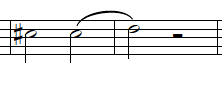
Here’s how that applies to trumpet.  Play this:

How much different is “C#” than “C”?  Now play this:

How much different is “D” than “C#”?   You see where I’m going.

If “C#” is virtually the same as “C”, and “D” is virtually the same as “C#”, then “D” is virtually the same as “C”, and so on until the entire range of the trumpet is virtually the same as “C”.

The goals of this exercise, which starts at “C” and goes to “F#” below the staff and “F#” above the staff are twofold:

  1. To systematically build coordination throughout the entire range of the trumpet, and
  2. To minimize the physical adjustments trumpet players make to play high or low.

Before I finish, let me make clear something I’m NOT saying.  I am not saying that there are no adjustments that happen between notes.  What I am saying is that trumpet players can spend too much time focusing on those adjustments, and in doing so, overdo it.  The physical changes that occur between notes are very small.

This exercise can be a first step in gaining the technique of playing the whole range of the trumpet.  Make sure to balance your practice of technique with music.  Here’s how to use some very simple tunes to solidify that range.

Open your Arban’s book to page 191.  Yes, to “The Art of Phrasing, 150 Classic and Popular Melodies.”  These are perfect for a musical application of the same technical exercise discussed above.

  • Play #1, “Robin Adair” as written.  The range is one octave, from “G” in the staff to “G” on top of the staff.
  • Now play it up a 1/2 step, with the goal of retaining the ease and fullness of sound from the 1st time.
  • Keep going up by 1/2 steps.

This can work with any piece of music.  I choose to start with the melodies in the Arban’s book because they are relatively short and musical.

The good news is this:  Anyone can do this.

The bad news is this:  It takes regular dedicated practice.

  • Regular means that a little bit every day is better than a lot one day and none the next.
  • Dedicated means paying attention to detail while practicing.
  • Practice means working towards getting better, not just going through the motions.

Let me know how it’s going.

Now get to work.

h1

The Secret to High Notes-Part 1

September 27, 2011

All right trumpet players, let’s talk about high notes.

First, let’s deal with 2 of my favorite excuses about why you can’t play as high as you’d like:

1)  You’re born with it.

  • That’s right, if you weren’t blessed with a Double-C at birth, you’ve got no shot.  This is my personal favorite.  It’s the greatest cop-out in trumpet.  In any beginning band section one kid will have an easier time making a good sound, another kid will have an easier time coordinating fingers, and another kid will have an easier time playing higher.  All teachers seem to agree that you can practice towards a better sound and better fingers, so why is it such a leap to think you can also practice your way to better range?

2)  If I could just find the right mouthpiece then all of my problems would be solved.

  • For you equipment junkies, read this carefully:  There is no magic mouthpiece.  Certainly the right equipment can make your job easier, but it is no substitute for dedicated, smart practice.  “Right equipment” is a relative phrase.  Just because a player you admire plays a certain mouthpiece does not mean it is the right mouthpiece for you.

Feel free to add your favorite excuses in the comments.

Now that we’ve gotten rid of the excuses, here’s the secret:

There are no high notes

I know, now you feel cheated.  Follow me on this and it will help.  If we can agree that a 3rd space “C” is not a high note (and I think we can), then since “C#” is only a 1/2 step higher, it certainly doesn’t qualify as a high note either.  And “D” is only a 1/2 step higher than “C#”, so it can’t be a high note.  Well, “Eb” is only up another 1/2 step, so it can’t be high.  You can keep going as long as you’d like.  Now we know there are no high notes.  Now what?

Now we need a better mental picture.  Because of the way music is notated, it’s very common to picture high notes as “up” and low notes as “down”.  This leads to 2 very common problems:

  1. Over-relaxing to play low.  Players will let go of all support and get that really special tube sound so familiar to beginning band directors.
  2. Over-tightening to play high.  Players will tighten up every part of their bodies just to squeeze out a note they think to be high.

So forget up and down.   Now go and look at a piano (it’s okay, I’ll wait)……..

Is it any harder to play high (or low) on a piano?  No.

Why?

All of the notes are right in front of you

That’s your new mental picture.  The entire range of the trumpet is right in front of you.  Now you only need one thing to access it:

Coordination

It’s not just air, or just tongue arch, or just any other single thing.  It’s coordination.

Part 2 (Coming Soon!) will deal with how to build that coordination throughout the entire range of the trumpet.

h1

Motivation

September 21, 2011

Let’s start with the easy stuff:

  • Music is not about winning.
  • There is no Best Trumpet Player.
  • Music is not about winning.

I grew up in the extremely competitive environment of Texas bands.  There is no doubt in my mind that the hours of rehearsals getting ready for, and number of performances in competitions helped me become a better trumpet player and musician.

But if I used the competitions as my only motivation, I would have peaked at age 17.

My motivation is very simple: I want to be great.  I want to be a great musician, a great trumpet player, a great teacher, a great performer…well, you get the picture.

Competitions and auditions can be great short-term projects.  They are not long-term goals.  You can be extremely motivated to win a competition or audition.  You work really hard, do your best, and sure enough you win.  Congratulations.  Now what?  Are you done now?  If you’ve won a job, does that mean you’re finished growing as a musician?  I hope not.

It’s time to starting thinking big.

I mean really big.

Now get to work.

h1

Listening

September 12, 2011

Last night, I watched “Mel Brooks and Dick Cavett Together Again.”   It was an hour of the two of them reminiscing about their life in show business, which included several stories about their interactions with various celebrities.  They talked about Alfred Hitchcock and Cary Grant like, and I know this may sound silly, they were real people.

This is exactly how you need to be listening.  It’s easy to listen to recordings of your favorite artists and groups and, although intellectually know they are real, think of what they are doing as some magical-mystical-music-making that doesn’t exist in the same plane of consciousness as you.

This is Step 1 in Listening: Demystification.  The people making the music you respect are, in fact, real people.  Your favorite musician could be someone’s annoying friend who won’t stop forwarding jokes that weren’t funny before the internet existed.  Or worse- a Notre Dame fan.

Step 2 involves some logic, so follow me here:

  • I want to be able to do what my favorite player does on a specific recording.
  • Since my favorite player did it, it can be done.
  • Since it can be done, why can’t I be one who does it?

Once you start answering “why can’t I do it?” you may have some more stuff to practice.  Now instead of listening and just being amazed by the people you respect, you can use what they have done to help you grow.

Step 3 is to play along with your favorite recordings.  I have found that jazz players do this more than anyone else.  The benefits are not limited to jazz soloists.

For orchestral players:  If you’re working on any excerpt, listening to a few recordings should already be on your practice list.  Now add “Play along with recording” to that list.  If you’re matching your favorite 1st trumpet player in sound, time, pitch, articulations, and style- then you must sound pretty good.

Lead players: It’s difficult to learn how to play lead without playing with a good band.  Spend some time transcribing your favorite lead trumpet parts and playing them with the recordings.  The lead trumpet part is generally the easiest to transcribe, as it’s the top melodic voice of the band most of the time.  If you’re matching the lead player’s sound, time, pitch, articulations, and style- then you must sound pretty good.  (hmmm…..I sense a pattern here)

Classical Soloists:  Unless you have an accompanist at your beck-and-call, it can be challenging to practice performing a solo.  There are some good accompaniment tools out there, but why not play along with your favorite recording?  If you’re matching….well, I think you get it by now.

It’s time to make listening a real and productive part of your practice.

Now get to work.