Now that we’ve got a better mental picture of the entire range of the trumpet (see Part 1), it’s time to build coordination throughout that entire range. We’re going to start in what I believe is the middle of the trumpet range-wise. That means 3rd space “C”. Here’s why:
- There’s an octave-and-a-half to low “F#”. Any lower is pedal tones.
- There’s an octave-and-a-half higher to high “F#”. This is where all of the valve combinations overlap and any note can be played with any fingering.
The concept is simple:
If you can play a 3rd space “C”, then you can play the trumpet.
Step 1 is to create a great 3rd space “C”. Now we’re going to take that approach with us throughout the range of the trumpet.
But first, a little bit of math (Woo-hoo!). We all know that:
If a=b and b=c, then a=c.
Here’s how that applies to trumpet. Play this:

How much different is “C#” than “C”? Now play this:
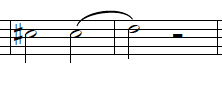
How much different is “D” than “C#”? You see where I’m going.
If “C#” is virtually the same as “C”, and “D” is virtually the same as “C#”, then “D” is virtually the same as “C”, and so on until the entire range of the trumpet is virtually the same as “C”.
The goals of this exercise, which starts at “C” and goes to “F#” below the staff and “F#” above the staff are twofold:
- To systematically build coordination throughout the entire range of the trumpet, and
- To minimize the physical adjustments trumpet players make to play high or low.
Before I finish, let me make clear something I’m NOT saying. I am not saying that there are no adjustments that happen between notes. What I am saying is that trumpet players can spend too much time focusing on those adjustments, and in doing so, overdo it. The physical changes that occur between notes are very small.
This exercise can be a first step in gaining the technique of playing the whole range of the trumpet. Make sure to balance your practice of technique with music. Here’s how to use some very simple tunes to solidify that range.
Open your Arban’s book to page 191. Yes, to “The Art of Phrasing, 150 Classic and Popular Melodies.” These are perfect for a musical application of the same technical exercise discussed above.
- Play #1, “Robin Adair” as written. The range is one octave, from “G” in the staff to “G” on top of the staff.
- Now play it up a 1/2 step, with the goal of retaining the ease and fullness of sound from the 1st time.
- Keep going up by 1/2 steps.
This can work with any piece of music. I choose to start with the melodies in the Arban’s book because they are relatively short and musical.
The good news is this: Anyone can do this.
The bad news is this: It takes regular dedicated practice.
- Regular means that a little bit every day is better than a lot one day and none the next.
- Dedicated means paying attention to detail while practicing.
- Practice means working towards getting better, not just going through the motions.
Let me know how it’s going.
Now get to work.


 Tartellog